


Why a little more gross can produce a lot more cash — and an even larger lift in what the practice is worth
By Derek Hill, CPA, CA — my thinking, my outline, AI-assisted drafting.
Abstract
After forty years of valuing and advising Ontario dental practices, I can state the premise in one sentence: Equity Lift finds the constraint holding a practice’s revenue where it is, removes it, and applies arithmetic to the newfound revenue. In 1984, Eliyahu Goldratt published the Theory of Constraints — in any system, output is governed by a single weakest link, and effort applied anywhere else changes nothing at the level of the whole. For years I have argued the companion point that every additional dollar of Incremental Gross Revenue in a dental office carries a far higher margin than the first dollar, because of what the fixed cost base has already been paid for. Put the two together, and the result is that a modest revenue gain becomes a large cash flow gain and a larger equity gain again. This article sets out the premise and the arithmetic behind it.
One dollar of new revenue is worth $3.30 of practice value
In an Ontario general dental practice, one additional dollar of gross revenue is worth roughly three dollars and thirty cents of practice value.
Not a dollar. Not the twenty-four cents the owner has been trained to expect. Three thirty.
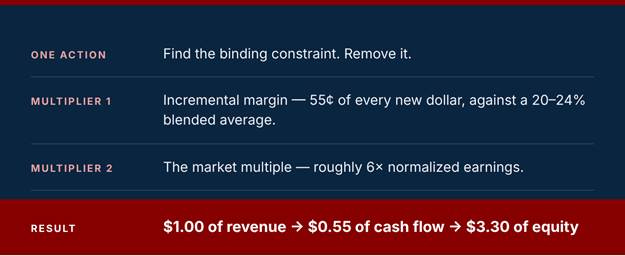
The arithmetic is not complicated. A dollar of revenue produced by removing a genuine constraint carries only its own variable costs, so about fifty-five cents of it reaches cash flow. Ontario general practices currently trade at roughly six times normalized earnings. Fifty-five cents, capitalized at six, is $3.30.
Almost no owner believes this, and the reason is not a failure of intelligence. It is that the number every owner has heard annually for twenty years — the blended margin of twenty to twenty-four percent — is the right number for the questions his accountant is paid to answer, and the wrong number for every question about growth. Applied to a growth decision, it understates the return by more than half.
A practice we valued at $3.5 million sold for $5 million two years later
For twenty years I ran Hill Kindy as a dental practice enhancement consulting firm. Our approach was that if something was broken, we fixed it. Most of the time we got results, and we were particularly good at relieving the non-cash-flow stressors that make ownership unpleasant. Sometimes, the bottom line was less reliable. We would work on eight things at once, improve all eight, and mysteriously find that earnings had barely moved.
One engagement showed me why. We valued an office at about $3.5 million. It had a large patient base and a badly run hygiene program — recall and periodontal both. When the front desk could not reach a patient after a couple of calls, they deactivated the patient to clear their own worklist, which removed that patient from any further recall effort. We told the owner to take the practice off the market and fix hygiene. Two years later it sold for $5 million. Hygiene revenue increased significantly with reasonable, not onerous, effort, and because costs did not rise proportionately, most of the increase reached the bottom line.
One and a half million dollars of additional value. What produced it was not a large operational program. It was one system, repaired.
At the time I credited the result to good consulting. What actually happened was that we had, without setting out to, removed the one thing governing the rate at which that practice converted patients into completed treatment — and then collected on operational leverage that had been sitting in the practice the whole time, inaccessible. Two principles, and we had stumbled into both.
Everything below is an attempt to stop stumbling.
The work you have already done never reached the thing governing the result
Most consultants arrive at the same diagnosis. The practice has multiple problems. Marketing should be improved. Scheduling should be tightened. Case acceptance should be addressed. The team needs training. The website needs refreshing. The recall system needs work. A list of eight or ten initiatives is produced, ranked roughly by visibility, and the owner is told that working through it will produce growth.
So the practice goes to work. Initiatives launch, staff are trained, systems are tightened. And throughput is still governed by whichever single resource was binding before any of it began. Unless that resource happened to be on the list, in the right position, with enough attention actually allocated to remove it, nothing changes at the level of the whole practice.
The other nine initiatives were not done badly. They were aimed at parts of the practice that were not governing the result. What the owner gets is more organized marketing, more disciplined scheduling, sharper case presentation, refreshed branding — and the same revenue and the same cash flow as the year before.
Owners who have been through this describe it almost identically: we did a lot of things, the practice runs better, but I can’t see it in the numbers. The observation is correct. The work simply never reached the one thing governing the outcome. That is not a failure of effort. It is a failure of aim.
One weak link governs the rate. The others wait.
In 1984 a manufacturing engineer named Eliyahu Goldratt published a short business novel called The Goal, about a failing factory and the manager who works out why. Goldratt’s principle, the Theory of Constraints, is hard to unsee once stated: the throughput of any system is governed by its single most constrained resource, and only by that resource. Effort spent elsewhere produces no additional output — only inventory piling up in front of the bottleneck and idle capacity behind it.
The principle does not need a factory. It needs only a system in which work flows through sequential stages to produce an output, and a dental practice is exactly that. Demand arrives at the front desk and moves through scheduling, hygiene, examination, diagnosis, treatment planning, restorative appointments, and finally to billed completion. At any moment, one of those stages is setting the rate at which patient demand becomes completed, billed treatment. That stage is the binding constraint. Every other stage has capacity to spare.
The principle is not confined to small business either. Writing in August about the capital flooding into artificial intelligence, Alex Wissner-Gross described money removing the compute bottleneck — not of chips but of electricity — to the point where engines are being stripped off private jets to generate power for data centers. Different scale, identical behavior: a system cannot outrun its current constraint. The moment the primary constraint is removed, the “secondary” constraint steps up to take its place, and the process starts all over again until in theory all of the constraints are removed.
What it looks like when the constraint is recall
Consider a practice where Recall Compliance and Capacity are binding. Hygiene is supposed to be prebooked, but in fact is usually spotty. Hygienists run behind. Recall compliance sits below sixty percent. Or a new patient cannot safely be offered an initial hygiene appointment for six weeks. The diagnostic engine of the practice — the hygiene visit that produces the examination that produces the treatment plan — has slowed to a crawl, and everything downstream with it.
Now put a ten-item improvement program into that practice, none of it addressing recall. Marketing improves and new patient calls rise twenty percent. The front desk converts those calls better. Case presentation sharpens and acceptance improves. The website is refreshed. The team is trained.
A year later: the additional new patients are waiting eight weeks for an initial hygiene visit instead of one or two. Acceptance is higher on the treatment plans that get presented, but the number presented is governed by the number of hygiene visits, which has not changed. The team is now capable of producing more work than the practice produces. Revenue is roughly what it was. Everything is better organized and the bottom line has not moved.
Recall was governing all of it. Any plan that did not address the recall system (constraint) would never change the result — and the ten-item program made the practice better at everything except the one thing that mattered.
The constraint can be identified from outside the practice
A fair objection: granted there is one binding constraint, can anyone reliably tell which one it is without living inside the practice? In a market of arbitrary operating structures, no. In the Ontario general dental practice market, yes — for three reasons.
Regulation narrows the possibilities. The Regulated Health Professions Act and the Dentistry Act define what dentists, hygienists and assistants may each do. The same regulated roles, the same scopes of practice, and the same dominant fee-for-service-with-private-insurance model produce the same recognizable chokepoints across practices of a similar profile.
The inventory is small. Forty years of valuation and advisory work has produced eight operational weak links that between them account for the substantial majority of binding limitations. Identification can be selected from a known list, not invented from imagination.
And each one leaves a distinct trace in operating data. Recall reveals itself in whether a new patient can be offered a hygiene appointment within a day or two. Case acceptance reveals itself in diagnosed treatment left unscheduled as a fraction of trailing production. Reactivation reveals itself in the shape of the lapsed-patient cohort. The traces are not subtle, and they are not interchangeable.
The incremental dollar is worth more than twice the average dollar
A large share of dental practice cost is fixed: premises lease, equipment lease, base administrative wages, software subscriptions, professional dues, base insurance, debt service on capital invested. These are committed. They do not move if gross fees move modestly in either direction, and they must be absorbed by whatever revenue the practice produces.
The costs that genuinely scale with revenue are a narrower set: dental supplies, lab fees, hygienist compensation for incremental hours worked, and dentist compensation for incremental clinical production.
So when a practice removes a constraint and produces new revenue, the cost of that revenue is not the practice’s average cost ratio of 75 to 80 percent, after paying all dentists as associates. It is the variable cost ratio applied to the specific work involved. Two constraint families, two answers.
Hygiene-driven removal — about 65 percent
Removing a Recall Compliance and Capacity constraint — through systematic recall outreach, tighter hygiene scheduling discipline, or a properly structured periodontal program — produces additional hygiene revenue. Only two costs scale with it: dental supplies at roughly 7.5 percent of incremental hygiene fees, and hygienist compensation at roughly 27.5 percent, depending on the compensation structure and whether additional hours are actually required. Everything else is already paid for. The same premises serve the extra appointments, the same equipment, the same base administrative team, the same software, the same insurance, the same debt service, the same dues. Sixty-five cents of every new hygiene dollar reaches cash flow.
Dental-driven removal — about 45 percent
Case acceptance, patient reactivation, front desk conversion and owner clinical scope produce additional dental revenue instead, with a different cost structure:
• Lab fees: roughly 10 percent, varying with case mix — crown and bridge carries more, simple restorative less
• Dental supplies: roughly 7.5 percent
• Dentist clinical compensation: the normalized 40 percent of gross-after-lab, which works out to about 36 percent of dental gross
• Other variable costs: bank charges on incremental card processing and incremental office cost, roughly 1 percent
That is about 55 percent variable, leaving an incremental margin of roughly 45 percent — against the 20 to 24 percent the owner expects.
Blended across both families, a working assumption of 55 percent is reasonable. The incremental dollar is therefore worth more than twice the average dollar, and the difference is not a forecast. It is a consequence of the fixed cost base already having been absorbed by the revenue the practice was producing anyway.
The multiple triples it again
Ontario general practices are currently trading between roughly 5.5 and 6.25 times normalized earnings. Call it six.
That is the third stage. Fifty-five cents of incremental cash flow, capitalized at six, is $3.30 of equity for every incremental dollar of gross revenue. On $10,000 of new revenue: $5,500 of cash flow, $33,000 of value.
A word about multiples, because owners are rightly suspicious of them. A multiple is the inverse of a return on investment — six times is a 16.7 percent annual return. A practice sale is an exchange of a lump sum today for a stream of income over time, and two things move the multiple factor of that exchange: interest rates and perceived transaction risk. Higher rates push the multiple down. Higher risk pushes the multiple down. In the window after COVID and before inflation arrived, RBC prime sat at 2.45 percent against 4.45 percent as I write, and multiples were correspondingly higher — I am aware of consolidator transactions consummated above ten times and dentist-to-dentist transactions around eight.
The multiple will move again. The relationship will not. Whatever the multiple happens to be, it applies to the incremental cash flow exactly as it applies to the rest.
What this looks like on a $2.4 million practice
A fifteen percent revenue gain, at the blended 55 percent incremental margin, valued at six times:
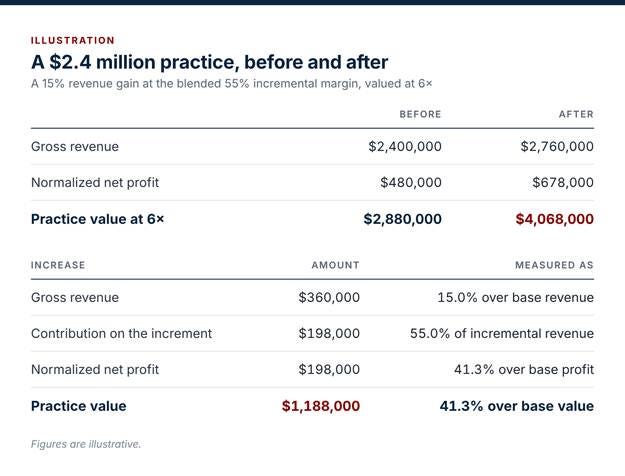
A fifteen percent increase in revenue produced a forty-one percent increase in earnings and a forty-one percent increase in value. Each incremental dollar of revenue added $0.55 of cash flow and $3.30 of practice value. The figures are illustrative.
Your accountant is using the right number for the wrong question
If the leverage is this large, why has nobody pointed it out?
Because owners and accountants think in averages, and there are respectable reasons for it. There is an annual publication describing the average Ontario practice — average revenue, average costs, average net profit — and it sets up the question I have been asked a thousand times: how does my practice compare to the average? It is useful information. It also trains everyone involved to think in averages rather than increments. Average, as the saying goes, is the best of the worst or the worst of the best.
The accountant’s annual conversation with the owner is a backward-looking summary: trailing twelve months of revenue, trailing twelve months of expense, and the blended margin that falls out of dividing one into the other. The accountant is not wrong to work this way. Tax filings use the blended figure. So do bank covenants and the lender’s debt-service-coverage calculations. For the questions the accountant is being paid to answer, the blended margin is the correct number.
The damage happens when the owner carries that number forward into a decision about growth. He has heard twenty percent, maybe twenty-four, across so many fiscal years that it has become the practice’s identity. An opportunity appears that would produce $100,000 of new revenue. He applies twenty-four percent, concludes it is worth $24,000, decides it is not worth the disruption, and declines it.
That same $100,000, aimed at an actual constraint, produces $45,000 to $65,000 of cash flow — and $270,000 to $390,000 of practice value. The opportunity dismissed as marginal was the largest one on the table.
Where the constraint usually is — and what has to be true first
Forty years of pattern produces eight operational weak links. In the scan order the methodology uses: Recall Compliance and Capacity; Affordability; Case Acceptance; Patient Reactivation; Front Desk Conversion; Owner Clinical Scope; Periodontal Program; Practice Facility.
Each is a recurring pattern in Ontario general practice. Each has a diagnostic signature in operating data, a defensible benchmark, and a removable cause. Each will get its own article over the coming year.
But the list is not the methodology, and this is the distinction that matters: we do not work on eight. We determine which one is binding, remove it, remeasure, and only then ask what has become binding next. A practice working on eight things is a practice working on seven things that will not change its result. The list exists to make the selection disciplined — not to become a program.
One note on the eighth. Practice Facility is rarely the binding constraint, and owners reach for it first because chairs and operatories are visible while operational constraints are not. It becomes binding only after the operational constraints have been cleared, which is a real and rather pleasant problem to have. It is not where most practices are.
The precondition: staffing capacity
There is a ninth element that is not a constraint at all. Staffing capacity is not something the practice does well or badly; it is the workforce that does everything else. Where there are chronic vacancies, turnover well above the natural replacement cycle, persistent reliance on temporary or locum coverage to keep chairs open, or key roles held by people working below the competency the role demands, no operational improvement will hold. The recall protocol survives on paper but not in the operatory. The trained hygienist leaves. The new front-desk hire never learns the script. The work was not wrong; the practice could not hold it.
Staffing sits upstream of all eight and has to be resolved first. Ontario’s dental labour market through 2024, 2025 and into 2026 has made it the immediate binding condition in a meaningful share of practices, and it is the subject of its own article in this series.
Two next steps, both free
Most consultants begin by asking what should be improved. Equity Lift begins by asking what should be removed first. Over forty years I have found that difference decides whether the work ever shows up in the numbers.
If the pattern in this article is familiar — particularly a run of consulting initiatives that produced organized improvement and no measurable financial change — there are two next steps that cost nothing and commit you to nothing.
Take the Equity Lift Indicator. Thirty-plus questions, about fifteen minutes, online. You receive a written Practice Constraint Identification within 24 hours: the methodology’s diagnostic working hypothesis for your practice, including whether the staffing precondition is binding and, if it is not, which operational constraint is indicated. No fee, no follow-up unless you ask for one, and your data is not retained beyond producing your report. equitylift.ca
Read the next twelve months. We will be issuing a long-form analytical piece every second Thursday. The schedule ahead covers the staffing precondition, each of the eight operational constraints in turn, the application of the Theory of Constraints to practice operations, the arithmetic of operating leverage, and market conditions as they develop. Each piece is written to be useful on its own.
A little more gross. A lot more cash. An even larger lift in practice worth.
That is the premise, and it reduces to something a busy owner can hold in his head. There is one action: find the binding constraint and remove it. There are two multipliers, and neither has to be built, because both are already in the practice.
Equity Lift is not another consulting program. It is a different account of where practice equity comes from and what has to happen first for it to increase.
Derek Hill, CPA, CA, is the principal of Derek Hill Advisory Group Inc. (DHAG), a dental practice valuation and advisory firm in St. Catharines, Ontario. He has advised on Ontario dental practice valuations and transitions since 1987.
DHAG conducts Value Gap Analysis engagements that quantify the difference between what a practice is worth today and what it would be worth with its binding constraint removed. Details at equitylift.ca.
Nothing in this article constitutes a valuation, appraisal, or opinion of value in respect of any particular practice, and all figures are illustrative.