

Why the market may revalue dental practices before AI changes dentistry – they do not wait for reality – they price expectations
By Derek Hill, CPA, CA — my thinking, AI-assisted drafting.
Abstract
Watch YouTube for a night or two, and it is quite possible that you may think AI is just a big bubble, or that most of us aren’t going to have jobs in a couple of years. I have even written on the effects that a looming employment disruption could possibly bring to the dental profession. The truth is no one really knows. The underlying premise, however, is that corporations have a duty to their shareholders to make a profit. If a machine can do the same job as a human just faster and better, then count on the corporation to replace the human with a machine. What does this have to do with the value of your dental practice?
Markets- the stock market, the real estate market, the bond market, and any other market you can think of do not wait for negative changes to happen before they soften their prices or values. Market values are repriced the moment expectations about their futures change. Markets do not wait for the bad news; they react to expectations. Is this going to apply to the price of a dental practice? Yes, in fact, it already does, and in the next several years it may become a material fact of valuation. Let me explain.
1. The biggest misunderstanding in practice valuation
A purchaser does not buy historical earnings or cash flow – a big mistake in thinking.
Purchasers buy expected future earnings. Historical EBITDA or cash flow is simply the best available indicator of what future EBITDA or cash flow will be. The numbers on the last three years of financial statements are not the thing being purchased — they are the argument for what future EBITDA or cash flow might look like.
This distinction sounds academic until you follow it to its conclusion. If value is a function of expected future earnings, then value can change without the practice changing at all. The practice itself remains the same; however, the day buyers revise their view of the future, the price they are willing to pay revises with it. The challenge is their view of the future is an estimate, a hunch, a feeling, not reality.
The practice didn’t change; the buyer did.
I have watched this happen at the level of the individual clients for four decades. A practice that would have drawn six credible offers in one year draws two the next, with nothing on the financial statements to explain the difference. What changed in those cases was never the asset. It was the confidence surrounding the asset. What I want to examine here is what happens when that shift stops being local to one practice and becomes structural to the whole profession.
2. Markets have always worked this way
None of this is new. It is simply new to dentistry as a subject of conversation.
Take the following, for example
1. The big one right now is oil. Is the war on or is the war off? No sane person thinks war is good; however, depending on what the current “story” is, the price of oil either goes way up or way down – all on anticipation of future events affecting the Strait of Hormuz – events that have not yet happened.
2. Stock markets react to what investors think is likely to happen, not what has happened.
3. AI technology equities, in particular, reprice on expectations about products that do not exist yet.
4. Housing markets turn on anticipated interest rates, not current ones.
5. Commercial office space in every major North American city was marked down sharply the moment the market decided remote work might be permanent — years before lease expiries actually forced the issue.
6. Retail property multiples compressed through the 2010s on the anticipation of e-commerce displacement, well ahead of the store closures that eventually confirmed it.
7. Bonds move on expected inflation. Entire sectors are marked up or marked down before the underlying economy produces a single confirming data point.
Why? Because investors do not buy history. They buy what they perceive the future will be — and they buy it at whatever price their current confidence in that future can justify (Think SpaceX, which reached an early high of $225/share and then cratered to a low of $108/share).
A dental practice is an income-producing asset, purchased by a rational buyer, normally with 100% debt financing (in Canada). It is not exempt from the logic that governs every other income-producing asset. The only thing that has spared dentistry from a demonstration of that logic is that, in living memory, dentistry has not faced an uncertainty large enough to make buyers hesitate as a group (except during COVID, which had to do with one of the leading factors which we will get to – the lenders).
We have a new variable, however, that I think could change that equation.
3. The new variable
Into this well-understood mechanism, introduce a genuinely new variable: artificial intelligence.
I want to be precise here, because the temptation is to overstate. AI does not enter this story as a certainty. It enters as an uncertainty — and that distinction carries the entire argument.
Dentistry, with only a few exceptions, thrives on discretionary care. No one — not me, not the technologists, not the buyers — knows exactly how AI will reshape dentistry, employment, or the broader economy that funds discretionary care. But buyers do not need certainty in order to change their behaviour. They only need questions. And the questions have already started.
Will AI change patterns of employment, and therefore the employer-sponsored dental benefits attached to that employment? Will discretionary household spending — the fuel for elective and cosmetic treatment — come under pressure? Will diagnostic and administrative technology alter staffing models and the cost base? Will treatment acceptance soften as households grow more cautious? Will the economics of a general practice five years from now resemble the economics of one today?
Notice that not one of those questions is about a robot doing dentistry. That is the version of the AI conversation extremists tend to promote, and it is the least interesting one. Chairside clinical delivery is among the harder things to displace. The exposure is not in the operatory. It sits in the household that funds the operatory, and in the insurance arrangement standing between the two.
These questions matter not because we have the answers, but because uncertainty itself changes valuation. An asset whose future is confidently understood commands a premium. An asset whose future is contested commands a discount. That is true before a single one of these questions is resolved. It is, in fact, most true while they remain unresolved.
4. The AI Perception Gap
This is the idea I most want to put on the table, because I think it is where the practical risk lives.
The AI Perception Gap is the period during which buyer expectations change before practice earnings change.
During this gap, nothing in the operating reality of a practice has moved. Production remains stable. Collections are stable. The hygiene department is business as usual. And yet the price a buyer will pay may already have begun to adjust — quietly, and with no obvious cause anywhere on the financial statements.
That gap could last years. And for the owner who plans to sell somewhere inside those years, the gap is not a mirage. It is the difference between the value they believe they have built and the value the market is prepared to confirm reflected in a falling multiple.
The Perception Curve
Here is a framework (borrowed from Ray Dalio’s book How Countries Go Broke: The Big Cycle (2025) that illustrates how this works. This is my “Big Cycle.” I call it The Perception Curve, and it has four stages.
1. Confidence. Buyers believe the future will resemble the past. Multiples are high. This is the environment most practice owners have operated in for their entire careers — and the environment they unconsciously assume will still be there on the day they sell.
2. Uncertainty. Structural questions — AI chief among them — enter the buyer’s mind. Multiples begin to compress even though EBITDA is unchanged. This is the AI Perception Gap, expressed as a stage. Nothing has happened to the practice. Everything has happened to the perception of what could happen to it.
3. Evidence. Actual earnings begin to reflect whatever the anticipated changes turn out to be — up, down, or sideways. The market now has data rather than intuitive speculation.
4. New equilibrium. The market settles on a revised level, built on the new and now-confirmed outlook.
The critical insight is the ordering. Most owners assume valuation moves at Stage 3, when the numbers move. It doesn’t. It begins moving at Stage 2 — while the numbers still look pristine. By the time the evidence arrives, the repricing is largely done.
There is a corollary that matters more than the curve itself: the curve runs in both directions. A practice can move back toward Confidence. But it can only do so by emergence of the one thing uncertainty destroys — believable evidence. I will come to that.
5. Why dentistry is unusually sensitive
The answer is operating leverage, and it is worth doing the arithmetic rather than simply asserting it.
A dental practice carries a heavy base of fixed and semi-fixed cost: administrative and clinical staff, rent, equipment, technology, insurance, and the supply and laboratory relationships built around a certain volume of production. Those costs do not politely shrink in proportion when production dips. Several of them do not shrink at all.
Consider an illustrative general practice. The figures below are constructed for demonstration, not drawn from any particular file, and EBITDA is stated after market-rate compensation for all clinical production, including the owner’s.
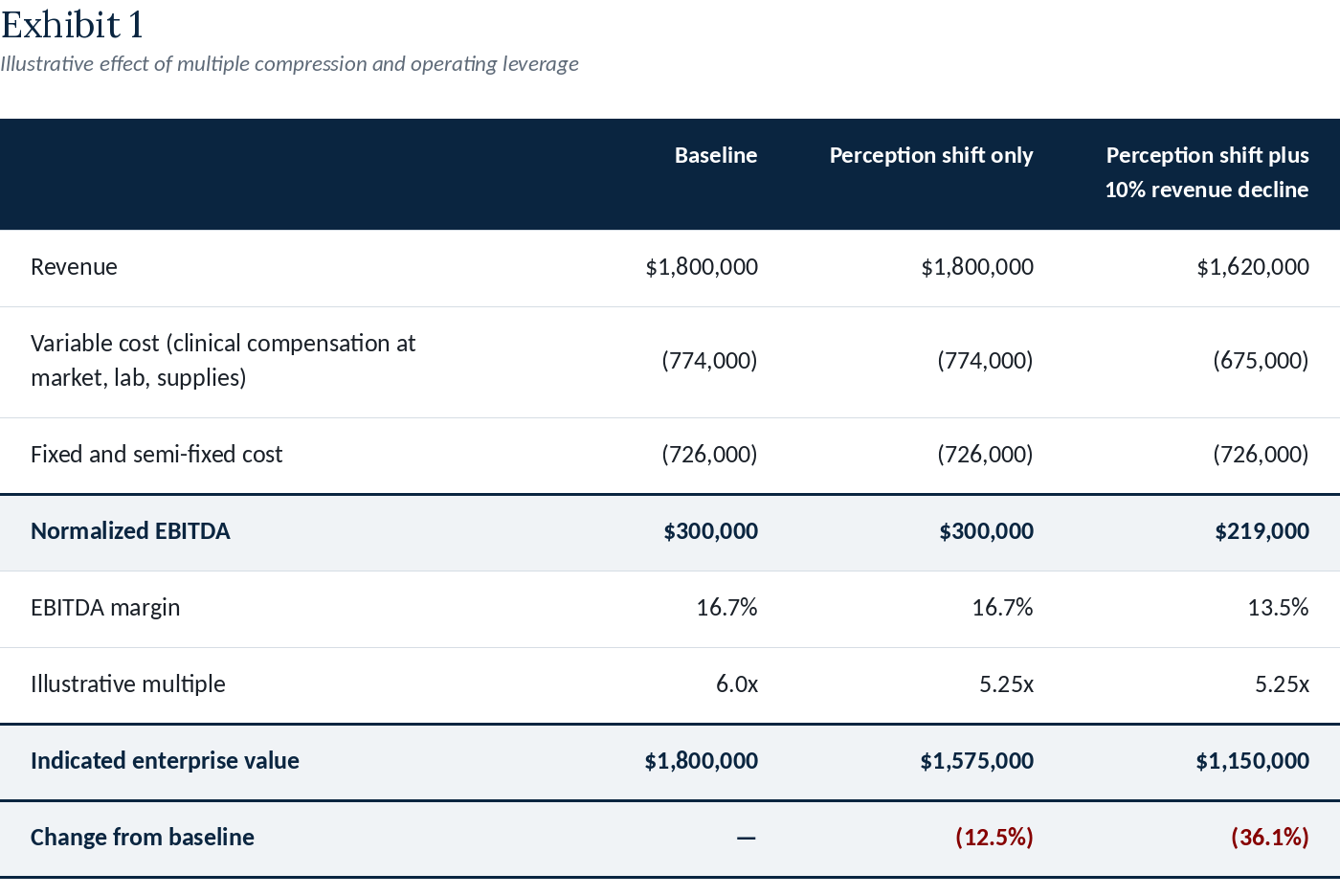
Exhibit 1 — Illustrative effect of multiple compression and operating leverage. Figures are illustrative only and do not represent any specific practice.
Two things in that exhibit deserve attention.
The middle column is the AI Perception Gap rendered in dollars. Revenue is unchanged. Costs are unchanged. EBITDA is unchanged. The only thing that moved is the multiple a buyer is prepared to apply to an outlook they have become less certain about — and $225,000 of indicated value has left the building. The owner has no way of seeing this on a financial statement, because it is not on the financial statement. It is in the market’s confidence factor.
The third column adds a modest operating decline on top. Revenue falls by ten percent. Because roughly 55% of the lost revenue carried variable cost with it — clinical compensation and laboratory — the remaining 45% flows straight to the bottom line. A 10% revenue decline produces a 27% EBITDA decline. Multiply that smaller EBITDA by the smaller multiple and the perceived or real (if executed) value falls 36%. The two effects do not add. They compound.
The composition of any decline matters as much as its size. A softening in elective restorative work carries some of its own cost away with it, because the dentist producing it is compensated on that production. A softening in hygiene does not. Hygiene hours are scheduled and paid whether the chair is full or not, which means an unfilled recall column flows to EBITDA at something close to one hundred cents on the dollar until the schedule is restructured. The normal backbone revenue in the practice is also the revenue with the least protection on the downside.
6. Where the pressure would come from
What would happen if AI disrupted employment and the economy.
Start with a single displaced worker. That worker, on average in Ontario, supports roughly 2.5 dependents — and when the job goes, so does the employer-sponsored dental benefit that covered all of them. Multiply that across a labour market absorbing a structural change where employer-sponsored insurance weakens in aggregate. Disposable income falls with it. And the first dental spending to be postponed is precisely the discretionary, higher-margin treatment that dentists rely on most for profitability.
Public programs fill part of the gap. The Canadian Dental Care Plan extends coverage to millions who previously had none — a genuine and important backstop, and one I do not want to minimize. But it is a backstop for basic care, and it reimburses below the private fee guide. If that reimbursement lands at roughly 80% of today’s fee guide (for example purposes only) — then every case that shifts from private-pay to public coverage arrives with a built-in margin and EBITDA reduction.
This is the heart of what I have elsewhere called the bifurcation of dentistry: publicly-funded basic care and private-pay discretionary care are drifting into two different businesses with two different economic profiles, increasingly delivered under the same roof. A practice’s exposure to everything in this article depends heavily on which side of that line its revenue actually sits — and most owners have never measured the split.
One further point about timing, because it is the part I find most uncomfortable. The chain described above does not transmit quickly. A displacement event does not produce a canceled crown the following month. Benefits often continue for a period. Households defer discretionary care before they defer hygiene. Patients drift out of a recall system rather than resign from it, and the practice does not register the loss until the reactivation report is run. My own working estimate is a lag in the range of 24 to 30 months from a displacement event to confirmed attrition visible in a practice’s own numbers.
If that estimate is even approximately right, it has an awkward implication. The earnings evidence that would settle this debate arrives roughly two and a half years after the conditions that caused it. Buyers and lenders will not wait two and a half years to form a view. They will form it now, on expectations — which returns us to Stage 2 of the Perception Curve, and to the gap.
7. The first response may come from lenders
Here is the part of this argument I think is genuinely under-appreciated, and it runs contrary to an assumption almost every owner holds.
Owners assume buyers determine value. But buyers typically pay with 100% borrowed money — and it is the bank that determines how much a buyer is able to borrow. Which means the first institution to reprice your practice may not be a buyer at all. It may be a lender.
Lenders do not need to see actual earnings decline in order to change their behaviour. They only need to grow more cautious about the sector. And the levers they pull are not dramatic. They are quiet, technical adjustments buried in a credit policy governed by credit officers, sitting in an “ivory” tower in Toronto, who know little about the operations of a dental office.
Rather than argue this in the abstract, it is worth looking at the arithmetic a credit officer actually runs.
Return to the illustrative practice from Exhibit 1 — $1,800,000 of revenue producing $300,000 of normalized EBITDA. Assume a purchaser buys it for $1,800,000, financed entirely with bank debt at 4.45% amortized over twelve years, principal repaid in equal instalments. Those are typical terms. Here is what the purchaser’s first year looks like, before and after the same 10% revenue decline that appeared in Exhibit 1.
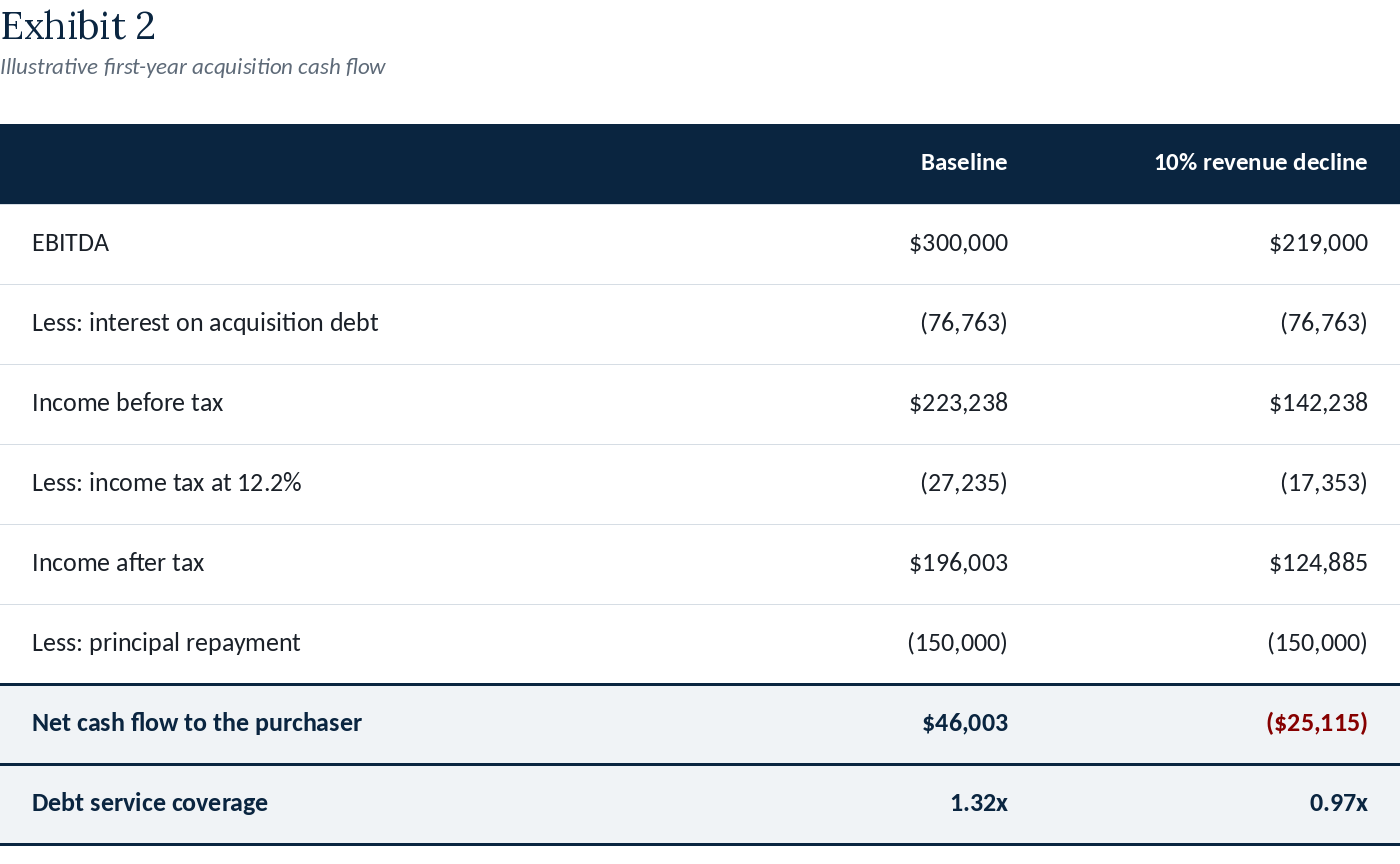
Exhibit 2 — Illustrative first-year acquisition cash flow, structured as principal plus interest, which is the customary arrangement for Ontario practice acquisitions: principal repaid in equal annual instalments of $150,000 over 144 months, with interest calculated on the average outstanding balance. The rate shown is 4.45%, full prime at the time of writing; acquisition lending is more commonly priced at prime less a quarter, at which the baseline surplus rises to roughly $49,800 and the decline scenario still produces a deficit of about $21,300 at 0.98 times coverage. Income tax at the Ontario small business rate of 12.2%. Figures are illustrative only and do not represent any specific practice.
Look at the baseline column first. A practice generating $300,000 of EBITDA, financed at a rate most purchasers would be glad to have, leaves the buyer $46,003 at the end of the first year. That is the whole cushion — about two and a half percent of revenue — before the new owner has drawn a dollar of personal income beyond their clinical compensation, replaced a single piece of equipment, or absorbed one unbudgeted expense. Debt service coverage is 1.32 times. It is adequate. There is nothing generous about it.
Now the second column. The same 10% revenue decline from Exhibit 1 — the one that took EBITDA from $300,000 to $219,000 — turns that $46,003 surplus into a $25,115 deficit. A swing of just over $71,000. Coverage falls to 0.97 times, which is another way of saying the practice no longer generates enough to service the debt used to buy it.
That is what a credit committee is looking at. Not a philosophical position on artificial intelligence, but a cash flow that fails at a ten percent revenue decline, on a practice that today looks entirely healthy.
So what does a lender do with that? It does not refuse to lend. It lends less. Run the same structure backwards: to hold coverage at 1.25 times on $300,000 of EBITDA, a purchaser can support roughly $1,905,000 of debt. Do the identical arithmetic on $219,000 of EBITDA and the figure falls to about $1,391,000 — a 27% reduction in what any qualified buyer is able to put on the table.
Set that beside Exhibit 1, which showed indicated value falling 36% once multiple compression and operating leverage compound. Two entirely different mechanisms — one a buyer’s view of the future, the other a credit officer’s spreadsheet — arrive at roughly the same place. About a third of the value, gone. That convergence is not a coincidence. Both are pricing the same uncertainty, and both do it before anything appears on a financial statement.
And notice that none of this requires earnings to have declined at all. A lender can reach a smaller number simply by tightening its own assumptions. Raising the coverage requirement from 1.25 to 1.40 times cuts borrowing capacity by about eleven percent on unchanged earnings. Shortening the amortization from twelve years to eight removes nearly a quarter. Each of those is a line in a credit policy, revised in Toronto, by someone who has never set foot in the practice.
There is one more lever, and it is quieter than either of those. A purchaser the bank regards as worth keeping can sometimes obtain a period of interest only at the front end of the loan. On the practice in Exhibit 2, that single accommodation is worth roughly $147,000 in the first year: instead of a $25,115 deficit after a ten percent revenue decline, the purchaser is $121,954 to the good, on identical earnings at an identical rate. It defers principal rather than forgiving it, but it decides whether the early years are survivable.
Which is rather the point. Rate changes that show up at the major banks are visible, and everyone attributes them to the Bank of Canada. Structure is invisible. An accommodation extended to a good customer is not published, is not contractual across the sector, and requires no explanation when it is withdrawn. A credit committee growing cautious about dentistry does not need to raise its pricing or tighten a coverage ratio. It can simply stop granting the interest-only year — and the posted terms look exactly as they always did.
No one announces this. There is no press release when a credit committee revises an internal industry risk rating. The buyer simply comes back with a lower offer, or a larger vendor take-back request, or a longer conditional period — and the vendor concludes that this particular buyer was not serious.
Prices adjust. Not because practices deteriorated. Because financing did.
This is why the AI Perception Gap could surface in the financing market well before it surfaces in the clinical one. Credit committees revise their models on expectations, the same as everyone else — and they tend to do it early and quietly.
8. What this argument is not
I want to be careful not to write a forecast dressed up as an analysis, so let me state plainly what I am not claiming.
I am not predicting that dental practice values will fall. The mechanism I have described is algorithmic, not deterministic, and it can run the other way. AI may compress the administrative cost base faster than it compresses demand, in which case margins improve. Public coverage may expand aggregate volume enough to offset the fee differential. Corporate and institutional demand for practices may continue to support multiples for reasons that have nothing to do with the underlying operating outlook. Any of those would blunt or reverse the effect I have set out above.
I am also not claiming a timetable. I am claiming an ordering — that expectation moves before evidence, which is a statement about how markets in general work rather than a projection of what the next three years hold.
What would tell me I am wrong? If a recordable period of uncertainty passes and multiples, lender coverage requirements, amortization terms, and discretionary treatment mix all remain unchanged. If all of this or a majority of this takes place, then the transmission mechanism I have described is weaker than I believe it is, and owners can safely ignore this article. Those are observable things. I would encourage owners to watch them, because they are the leading indicators — and the financial statement is the lagging one.
9. The response: manufacture evidence
If the argument to this point holds, it points to a response.
The logic is simple. If markets begin to reward certainty and penalize uncertainty, then the rational move for an owner is to deliberately manufacture certainty: to give a buyer — and the buyer’s lender — fewer questions and more evidence. Concretely, that means six things.
● Increase recurring, predictable recall revenue. The hygiene department is the most annuity-like part of a practice and the part a lender underwrites most comfortably. It is also, as noted above, the part with the worst operating leverage if it softens.
● Increase EBITDA through operating discipline, not merely top-line growth. A dollar of margin recovered from a constraint in the existing operation is worth the same as a dollar from new production, and is usually available faster and at lower risk.
● Improve systems, so the practice runs on process rather than on the owner. Documented process is what converts a personal enterprise into a transferable asset.
● Reduce owner dependency. This remains the single largest source of buyer risk in most general practices, and it is the risk buyers price most aggressively because it is the one they cannot control after closing. Departing owner dentists create heightened risk.
● Demonstrate resilience across a range of conditions. Know the revenue split between discretionary and basic care. Know the exposure to any single insurer, employer, or referral source. A practice that can answer those questions is priced differently from one that cannot.
● Document future cash flow in a form a credit committee can actually underwrite. Not a “black box” projection. A defensible cash flow supported by realistic mathematics.
None of these change what AI will or will not do. What they change is the story the numbers tell about the future — which, as the opening section argued, is the thing actually being priced. This is precisely the work the Equity Lift methodology is built to do. Equity Lift is a program I developed at Derek Hill Advisory Group, and it rests on a single observation: because a practice is valued as a multiple of its earnings, a modest revenue gain at the right point in the operation produces a disproportionate gain in value. It begins with a diagnostic that identifies the one constraint doing most to limit a particular practice — on the principle that a system is held back by its tightest bottleneck, not by everything at once — and it ends with documented evidence of sustainable future earnings that a purchaser and a credit committee can actually underwrite. In the language of this article, it is a deliberate attempt to move a practice back down the Perception Curve, from Uncertainty toward Confidence. (www.equitylift.ca)
It is worth noting what this work is not dependent on. It does not require the owner to be right about AI. An owner who does this work and finds that the structural concerns never materialize has still built a more valuable, more transferable, more profitable practice. The asymmetry is favourable, which is the most one can ask of a decision made under genuine uncertainty.
Conclusion
Return to where we began.
Markets do not wait for reality. They price expectations.
The greatest threat to the value of your practice may not be artificial intelligence itself. It may be the earlier, quieter moment when buyers — and their lenders — begin to believe that tomorrow will look different from yesterday. That belief can move price up or down while your financial statements are still pristine, and by the time the evidence confirms or refutes it, the repricing will largely be finished.
Which leaves a final thought worth sitting with.
The value of a dental practice is determined twice. First by the owner, through years of building it. Then by the buyer, through years of imagining its future.
You control the first entirely. The Perception Curve is about how much you can still influence the second — and the window in which to do it is the gap itself, while the numbers still look like they always have.
Small revenue gains. Large valuation gains.
Derek Hill, CPA, CA is the principal of Derek Hill Advisory Group Inc., a dental practice valuation and advisory firm established in 1987 in St. Catharines, Ontario. Equity Lift is a DHAG program. Nothing in this article constitutes a valuation, appraisal, or opinion of value in respect of any particular practice, and all figures are illustrative.
Announcement: Watch for the launch of the Equity Lift program mid-September and learn how you can control your Perception Curve.